Fall of France (1940)
All the Light We Cannot SeeThe Fall of France (1940) marks the shift from anticipating war to living through its consequences. In the novel, that change is not confined to the battlefield: it is registered in museum crates and abandoned train journeys, in orders governing radios, and in the arrests and restrictions that follow. June 1940 provides the time marker for a collapse whose effects continue to shape the lives of Marie-Laure LeBlanc, Daniel LeBlanc, and others long after the first flight from Paris.
From preparation to flight
Before the exodus, the threatened collections of the museum are treated as things that must be moved and secured. Daniel LeBlanc works late, arranging padlocks and transport manifests as couriers carry collections toward country estates. Fossils, manuscripts, jade, cavansite, rhodochrosite, pearls, gold, and a large sapphire are among the objects requiring protection; Marie-Laure wonders whether the Sea of Flames might also be among them. The work makes the approaching crisis tangible through the administrative care required to move and safeguard cultural property.
As the danger intensifies, the museum changes function. Its workspaces are stripped of typewriters, and its halls become packing yards, with straw, sawdust, and twine spread across the floors. Elsewhere in Paris, people hide valuables in cellars, clothing, and book bindings. These measures suggest a population preparing to leave or to protect what it cannot take, even before the route and destination are clear.
In June, Daniel buttons Marie-Laure into a winter coat despite the summer date, and they leave their home carrying a rucksack. She keeps one hand on it and holds her cane in the other as they walk along the rue des Patriarches amid the movement of people around them. The disorientation of the departure is conveyed through her limited, fragmented grasp of events rather than through a strategic overview of the retreat.
The rail journey fails to provide an exit. By one in the morning, crowds are still pressing through the gates, the gendarmes have lost control, and no train has arrived or departed for more than four hours. Marie-Laure sleeps on her father’s shoulder. At dawn, with the trains still absent, Daniel decides that they should continue on foot. The failed timetable turns evacuation from an organized passage into a decision made amid congestion and uncertainty.
Institutions under pressure
The museum’s preparations and the public flight belong to the same unfolding emergency, but they expose different forms of loss. Collections are sorted, crated, and sent away under procedures intended to preserve them; ordinary people conceal possessions wherever they can. The contrast places professional systems of protection beside improvised household measures. Both are responses to danger, but neither can make the broader situation secure.
The novel also sets human movement against a landscape that briefly seems untouched. Deliveries to the museum stop, sandbags appear at its gates, and soldiers watch from the roof of the Gallery of Paleontology. Yet the sky remains empty of the aircraft the watchers expect, while songbirds return and the seasons move from spring toward summer. The uneventful sky does not cancel the preparations below it; instead, it makes the interval between anticipation and visible attack part of the experience of wartime.
Occupation and coercive rules
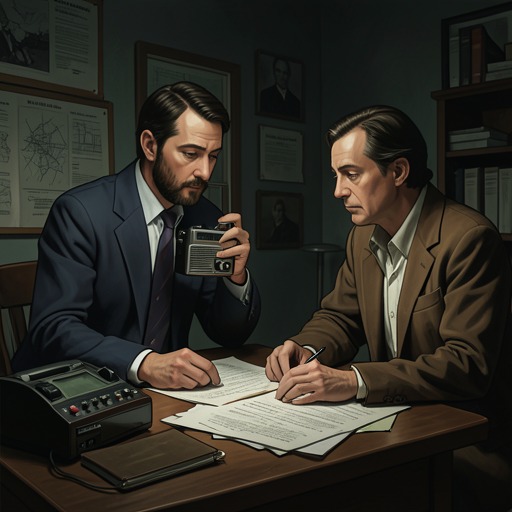
The fall’s consequences persist in the rules imposed on people and property. In Saint-Malo, Marie-Laure has to press her father to read aloud an order requiring residents to surrender their radio receivers by the next day. The notice threatens arrest for anyone who fails to comply. Its administrative wording makes listening equipment an object of state control and turns possession into a test of obedience. For a family whose lives are connected to radio, the order is also a direct restriction on communication.
Daniel’s arrest shows how quickly suspicion can overtake ordinary travel and work. He is seized outside Vitré while on a train, and officers take his notebook, tool case, and key ring. They count seven skeleton keys and question him about the locks, files, saws, and architectural measurements he carries. The questioning shifts from French officers to German interrogators; the latter appear to suspect that he intends to destroy the Château de Saint-Malo, though the basis for that accusation remains unclear. They refuse him paper, linens, and access to a telephone. The episode presents detention not as a transparent legal process but as an encounter in which practical tools and professional notes can be recast as evidence of a supposed threat.
A later order extends control from property to movement and the population itself: men between sixteen and sixty are to assemble at the château tower and be marched to Fort National at low tide. The order’s age range and designated route give the roundup the appearance of procedure, while its consequence is the forced removal of men from the town. Set beside the radio surrender notice and Daniel’s interrogation, it shows occupation acting through successive demands, searches, and detentions.
Wartime life beyond the first exodus
The novel’s wartime record also reaches through letters and domestic details. A letter signed by Frau Elena worries that a professor’s broadcasts have gone unheard for at least two months. She reports that a powerful transmitter in Brandenburg overwhelms much of the dial and considers whether radio signals could be received through metal in a tooth. The question belongs to a world in which communication remains possible but uncertain: the listener cannot know whether a silence means that the broadcaster has stopped, the station has failed to forward a message, or the receiver can no longer find the signal.
In a letter to Werner Pfennig, Jutta describes foundries working day and night, fuel shortages, and the use of whatever materials can be burned to keep warm. She and others mend clothing at a laundry, where shortages mean that slipcovers, curtains, and old coats are brought in for reuse. The letter’s practical routine gives wartime scarcity a domestic scale: work, study, and repair continue, but the materials and conditions of daily life have narrowed.
A later letter from Werner to Jutta is heavily obscured by censorship marks. The readable fragments refer to shortages of paper and heat and recall Frederick’s view that each person’s path is predetermined. Werner’s own account of what he calls his mistake is hidden, leaving the reader with both the outline of his reflection and the enforced silence around its details. The censored letter makes the control of communication visible at the level of a private relationship, not only in public orders.
Significance in the novel
The Fall of France is therefore represented as a transition rather than a single bounded scene. The June departure from Paris establishes the immediate pattern of displacement; subsequent orders and arrests show how defeat becomes a continuing system of restrictions. Museum logistics, interrupted travel, radio controls, and forced assembly are different scales of the same upheaval, linking institutions and private lives without making their experiences identical.
The narrative’s attention to small objects and procedures gives the historical change its human measure. A cane and rucksack accompany Marie-Laure’s departure; seven skeleton keys become grounds for questioning Daniel; radios, letters, and reused clothing register later constraints. The fall is decisive because it transforms what people can carry, protect, hear, and do. Its consequences remain present in the novel not only as military history, but as the altered conditions under which its characters attempt to maintain work, family ties, and communication.